

Engaging Student Activism for Educational Justice: Afro-futurist Paths to
Empowerment and Lasting Change?
Introduction
The educational trajectory of African Heritage Students
(AHS) in Victoria is marked by systemic racism and exclusion. Despite
"multicultural" policies, AHS face significant barriers in education,
from economic deprivation and 'racialisation' to institutional bias and
bullying.
I've earned a competitive PhD scholarship to conduct a
qualitative scientific investigation. My research project, Engaging African
Heritage Student Activism for Educational Justice seeks to better
understand these issues by empowering AHS with an opportunity for scientific
action: co-research and Technical Philosophy. My Technical Philosophy is a
praxis and lifestyle which -during crises- employs my own style of Hacker
Activism (scientific ethical hacktivism) for systemic change.
African Heritage Students and Educators
More specifically, African Heritage Youth (AHY) in
Melbourne, Victoria face a complex landscape of multicultural aspiration
clashing with deep-seated structural racism and an enduring 'colonial' legacy
(Andrews, 2021). Educators and policymakers are also key stakeholders in this
narrative, as they play a crucial role in addressing these systemic issues.
African heritage learners more generally face widespread
hostilities, ranging from peer-to-peer and Teacher racist bullying,
administrator bias in primary schools, institutional racism in higher
education, exclusionary treatment in the economy and predatory treatment by law
enforcement. Evidence from the Victorian Department of Education in a recent
advertising campaign indicates AHY are already engaging in their own activisms
against racism. This study seeks to engage these youth.
See Anti-racism Activism Video from Department of Education below or here >: Anti-racism
at Braybrook College
It is an essential opportunity and critical time to
understand what ''activisms'' they are engaging in, what is or isn't working - in
their view, how they conceptualise educational justice and activism itself, and
how my Technical Philosophy as a liberation pedagogy anchored in afro-futurist
technology and wisdom could contribute to educational justice for African
heritage youth as well as African-heritage graduate researchers in higher
education, such as the investigator of this very project. How meta (nested
self-referential)?!
Systemic Racism and Educational Exclusion
Preliminary themes and a comprehensive review of the
literature indicate AHS in Victoria (similarly to other states in Australia)
experience an additional range of challenges that hinder their educational progress
(beyond ordinary academic challenges):
1.
Systemic Racism: The State of Victoria
presents a complex landscape where societal marginalisation and exclusionary
school discipline policies act as a primary funnel into the youth justice
system (Vaughans, 2021).
2.
Institutional Inertia: For AHS who
navigate secondary exclusion to reach higher education, the tertiary
environment presents "severe racism" (Gee, 2024) and institutional
inertia (Varcoe, 2006).
3.
Illegitimate Gatekeeping: Existing
academic assessment systems are not fit for purpose and invite bias and noise
from racist administrators and educations into grading resulting in appraisals
of student work which do not reflect their true competency.
4.
Administrative Gerrymandering: Student
Concerns and Reporting mechanisms are characterised as "high cost, low
reward," forcing students into silence and suffering or entrapments into
unjust and exhaustingly protracted bureaucracy that keeps students pushing
figurative wheelbarrows up hills, while trying to stay on top of their studies.
The insufficiency of static policy reform and its
discordance with implementations to counter these dynamic systems of exclusion
is a central problem. This study posits an urgent need for the exploration of
an applied "Technical Philosophy"—potentially operationalised in
times of crisis as a "Hacker Activism"—that functions as a praxis to
identify, deconstruct, and "patch" these institutional
"bugs" (to use the computer science and information technology
vernacular) in real-time and in compensatory and materially empowering ways.
It's this hacker ethos (of building and fixing) which takes its
meaning in context to a contrary mode of conceptualisation with cracker
(to break and destroy).
Issiah B. Burckhardt: Student Investigator
As doctoral research candidate, I'm conducting this project
with the support of Deakin University and the African Australian Community
through Community Service Organisations (CSO's) specifically Multicultural
Youth Group (MYG) headed by Mr Yusuf Liban. Attached (embedded below) is our community
partner letter of support.

With my background in educational counselling, media and
communications and my own technical philosophy developed over 25 years, I bring
a multidisciplinary perspective to the research with outputs designed for
maximum educational impact, often with commercial research spin-offs which
further enhance the real-world utility of the research. Some of my past
research outputs are built upon in this project, but my recent research outputs
which are most relevant and build on the digital auto-ethnography in this study
is briefly described and rationalised in how it contributes here:
1.
Analytic Rubrics in Summative Assessment:
Are Learners Due an Upgrade? (2021) This Master of Education research
thesis focused on the the validity and reliability of analytic rubrics in
summative assessment in Higher Education, highlighting empirically and
theoretically that grading with the collected rubric samples was invalid and puts
marginalised students at exponentially greater risk of academic sabotage by
assessors. This informs the enquiry into assessment and illegitimate
gatekeeping for this cohort as a wicked educational justice problem.
2.
Authoring a 217-page book, Machine
Generation: PRODIGY (2017) a memoir of creative
non-fiction documenting writing and publishing 130 live song performances in
one year where the skill of digital auto-ethnographic self-study has been
practised, from performance to publication.
3.
The conference paper and keynote speech Unlocking
the Educational Needs of African Heritage Students (2024) Established
the disconnects in the literature between AHS educational development needs and
existing provisions. Collected feedback and anecdotes from practitioners,
Community Service Organisers and parents around these obstacles and challenges.
It became soberingly clear that the Australian government's question of asking
"how to improve AHS school engagement?" was the wrong question
to ask.
4.
Designing GenAI Large Language Models for
Social Science Qualitative Coding (2024) This research output supports
advanced qualitative coding techniques and analysis for this project.
5.
*Illegitimate Gatekeeping in the Ivory
Tower? A New Model for Inclusive Assessment (2025) This research presentation drew themes
from preliminary empirical auto-ethnographic data highlighting a typology on a
visual topology of illegitimate gatekeeping tactics and strategies which are
lesser known in the literature, something which informs this investigation into
conceptualising an empirically informed understanding of educational injustices
which AHS are vulnerable.
6.
Occult Sociology: Ethically Detecting the
Hidden in Plain Sight.(2025) This research publication detailed the
bio-onto-epistemology underpinning a proposed sociology which is more reliable
and robust and theoretically reduces the likelihood of misattribution of
correlation in social science which focusses on "social justice".
7.
Anti-Racism a Dead-End, Scientific
Counter-Racism the Way (2025) This research output established a clean
break from the confusing, ineffective and circular thought and practice of the
anti-racist movement, offering a more logically, theoretically sound and
reasoned approach to counter-violence through a behaviourally codified
counter-racism which draws from recent social science developments gaining
ground in underground activist spaces.
8.
Eval Precis: Analytic Rubric Design
Assures Learning & Satisfaction of Doctoral Research Assessment (2025)
Consolidating earlier assessment discoveries and updating their context for
doctoral research, this project resulted in three development partners joining,
valuable feedback, project validation and the refinement of a design for a new
discipline agnostic doctoral research rubric which offers to save the time,
energy and accuracy of assessors graduate research appraisals while improving
learning and satisfaction of doctoral candidates towards their thesis or
portfolio assessment, removing opportunity for decision-maker noise and bias.
It also accounts for recent advances in Generative AI in academia.
9.
Home Education: A Child Welfare Priority
and Social-cohesion Imperative (2025) This research myth busts some of
the commonly held deep seated ignorance and superstitions which underpin
assumptions about AHS educational development where misattribution and
correlation misdirect families and learners away from the bio-onto-epistemology
of home education into institutionalisation under the legacy of
"colonial" surveillance and seemingly inescapable racist control.
10.
Delivering Workshops Youth
Entrepreneurship Blueprint (2025) for the Victorian Department of
Education and providing educational counselling through my EdTech start-up
contributes to my experience in delivering co-design focus groups and
co-research workshops with African Heritage Youth in this study. (I can be seen
in action, delivering one of my workshops in the linked
video)
Additional research outputs about intelligence grading, counterterrorism
and counter-intelligence assisted in researcher development and enriched
evaluation and assessment construct development and conceptualisations of
deception, the primary weapon of racist oppression in academia and beyond.
This aspect of my research supports the codification of non-physical violence,
such as racialisation and its damaging and injurious impositions on learning
and student livelihoods.
Some already accepted abstracts and publication research
outputs are TBA in 2026.
My familiarity with the theoretical landscape of the inquiry
and my technical, theoretical, critical analysis, and reasoning abilities
developed over time and emergent through this work are suited to this research
project.
Research Design and Methodology
The research employs a streamlined and focussed approach to
understand and address the systemic issues faced by AHS in qualitative and
multimodal ways:
1.
Critical Youth Participatory Action Research
(CYPAR): This involves an empirical component of foregrounding student
voice and sharing the "labour of inquiry" with African-heritage youth
participants, who act as co-designers in a focus group, whom convene together
with the student investigator (myself) on the co-research activity to perform
in a co-research workshop together. This empirical component is slated to begin
in 2026 over three months, with one session per month. Each monthly CYPAR
'session', comprises a 45 minute - 1.5 hour focus group of 8-12 students whose
meeting is audio recorded and transcribed, and a 2-4 hours creative workshop
where the artefacts generated form the output of the co-research activity as
action research intervention.
2.
Autoethnography of the Technical Philosophy:
I as the student investigator document the "lived friction" of the
academic process itself through "thick description" (richly
descriptive and associative) digital multimodal (multi-media). This self-study,
documents my research and Technical Philosophy praxis for Educational Justice
in the University.
3.
Technical Philosophy Praxis: This
methodology moves beyond observation to active intervention, utilising an
iterative "patching" model reminiscent of AGILE software development
but characteristic of the tradition of Youth and Critical Participatory Action
Research. This is accommodating the Youth experience, archetypically, while
acknowledging the criticality present in the situation and in the intervention
of action research. Education as Liberation has a long and rich history
(Friere, 1967, Spartacus R, 1980) and this project's conceptual framework
builds on this theoretical and practical history.
The project includes a preparatory and rapport-building
focus group which plans the co-research workshop. There is community engagement
in the development of documenting AHS action towards liberation, self-reliance
and self-realisation.
The completed research submission will comprise a curated
portfolio of Traditional Research Outputs and Non-Traditional Research Outputs
(NTROs), bridged by a substantial exegesis which explains and rationalises the
existence, inclusion and qualities of the research outputs from the digital
auto-ethnography and CYPAR with African Heritage Youth, elaborating on how the
project offers theoretical, methodical and empirical contributions to the
scientific community.
Risk Management
My Risk Portfolio
It is understood that the key predictor of failure is poor risk
management across many interconnected areas of a research project. My PhD
approach treats the entire project as a risk portfolio being actively managed
from the start, not something left to chance. With diminishing time and real-world
constraints, here I summarise the practical aspects of this project's risks.
This is not exhaustive; finer details are contained in the Project Description
Protocol (PDP) and Confirmation of Candidature Proposal, but these are some of
the more interesting ones for the attention of a more general audience here on
our blog;
Project design risks
•
Methodology risk: Projects with no prior
foundation or precedent carry high risk; So this project defers to lower‑risk
methods. Dr Sally Morgan (Monash University) was instrumental in this decision as
she recommended Participatory Action Research (PAR) where earlier methodologies
of my proposed project were focused on observation triangulated with interviews
in the form of a multiple case study. Critical PAR bundles a lot of those
methods into one holistic and cohesive set of methods, which is far more
economical and efficient pragmatically speaking. The nature of liberation and
resistance study was suited to this action research method also, further minimising
the risk of incongruences between research questions and methods.
•
Time risk: Each experiment or subproject
must being evaluated for how long it takes; after big changes to my supervisory
panel and lengthy back and forth in the confirmation of candidature process,
I'm front loading the empirical data gathering and technical philosophy praxis,
doing longer, riskier, time‑intensive work early, because later there is no
buffer to absorb failure or delays. (notwithstanding a 6-month scholarship
extension TBC). This approach meant publishing research outputs for feedback,
such as a slew of conference presentations, and planning that post ethic application-
all empirical data gathering (focus group and workshop session -1 per month),
happen in the first three months (post ethics). Limiting this project to one
empirical source (excl auto-ethnography) - Assoc Prof Trent Brown and Prof
Glenn Auld assisted with this streamline of the research design.
Data, equipment, and financial risks
• Data risk: I ensure open, reliable access
to required datasets and have developed enough analytic skill to interpret the
data rather than depending entirely on others. Conference papers about
advanced qualitative coding techniques allowed me to gain feedback on new
prototype developments of methodical and technological qualitative analysis
techniques, leveraging the latest in technology and computer science towards
natural language processing.
•
Equipment risk: Over‑reliance on a single
expensive or unique piece of equipment is hazardous because breakdowns,
unavailability, or key operators’ absence can stall the entire project, so I
hedge with alternatives and complementary directions where I own and operate my
technology infrastructure through my education research and development firm Genius.Tools.
•
Financial risk: Insufficient or unstable
funding, especially at supervisor level, can push rushed, ill‑chosen projects
onto students; a buffer of funding reduces this pressure and risk., in this
case, while grants, donations and business sponsors and partners are welcome, the
university funds for fieldwork are sufficient. Redundancies in venue access for
focus groups and workshops are also provisioned beyond host university
facilities, where community and local council representatives have bestowed
this project with in-kind and venue commitments. The nature of the commercial
research spin-offs also offers potential for some return on the research
investment. Letter of Support from Deakin Universities Business
Development can be read below.

Ethical, feedback, and skill‑gap risks
•
Ethical risk: Delays or problems in
ethics approval can stall research for months, so I understand timelines,
requirements, and have planned alternative work so progress does not depend on
a multitude of fieldwork method considerations and approvals. This also meant limiting the research design to one empirical
data fieldwork component with AHS triangulated by my digital auto-ethnography.
•
Feedback risk: Lack of timely,
substantive feedback from a supervisor is a major risk; as an already
marginalised student having overcome an entire schooling littered with
incidents of educational injustice, I've proactively built multiple feedback
channels (postdocs, senior PhDs, other academics) through building a surrogate
team of elite senior researchers and administrators across several
universities, so progress does not sit on one person’s desk. This was crucial
during the time I instigated changes in 2025 towards optimising my supervisory
team for educational impact.
Skill and health risk predictors
•
Skill‑gap risk: Failing to gain needed
skills (statistics, software, instrumentation) early forces heavy dependence on
others and introduces more risk later in the project. Here, my Individual
Learning Plan (ILP) includes evidence of sustained learning and researcher
development. My coding and programming skills and mixed-methods skills took a
leap, furnishing more advanced capability with R programming, natural language
processing and greater confidence in quantitative methods.
•
Health risk: Physical and mental health
problems, if unaddressed, compound all other risks; functioning well and having
appropriate support is essential for timely completion., so I've received
ongoing support with my disability and am grateful to be able t rely upon a
team of elite health practitioners. This has now developed into a practitioner
directory where I've started to build a professional network website which
others can use to make referrals to their own clients where culturally and
linguistically diverse health and educational service providers can be found.
This is another way to give back to the community. This same practitioner
referral website (under development) is the directory where my own study
participants can draw from for additional and therapeutic support. This is
ethically valuable and important to the community and an ethical requirement for
the project where referral pathways if and when incidences occur is essential.
Participate and Support
I invite educators, policymakers, and community members to
support this project. Here's how you can get involved:
•
Join the Mailing List: Help me drive
systemic change by supporting the project by staying up to date with my email
newsletter and sharing it with colleagues, friends and associates who might be
interested.
•
Engage with Research Outputs: Explore and
share my research outputs. Purchase and/or download and share my conference
papers (and supplements), journal articles, and creative artifacts with your
associates.
•
Participate in Workshops: If you are a
school principal or staff member, parent or community organiser with interests
in AHY education and well-being, get in touch to register your interest in my
educational workshops, which support collaborative problem solving with young
people. This way you can engage with the research and contribute to its
development more directly by assisting with student co-researcher recruitment
through a preliminary EOI.
Your involvement is crucial in addressing the systemic
racism and exclusion faced by AHS.
Consequences of Inaction?
Without interventions and engaged dialogues, which attempt
to gain greater understanding of the extant and potential problem solving by
the individuals facing those problems, the cycle of marginalisation and
exclusion will continue, perpetuating injustice and limiting opportunities for
AHS. The consequences of inaction include:
•
Continued ignorance about the marginalisation,
mistreatment and exclusion of AHS in the education system.
•
A persistent arrogance around the perpetuation
of systemic racism and its accompanying institutional inertia can continue to
be damaging and injurious to the African Australian Community, its Families and
children
•
Limited opportunities and sabotaging
circumstances inhibiting AHS from achieving their full potential mean, their
quality of life and survival is at stake
Educational Justice, What is it? and What does Empowerment look like?
The goal is to document the contributions of liberation
seeking youth and students as they
strive to achieve educational justice, empowering ourselves and each other to
overcome systemic barriers and achieve our potential- thereby guaranteeing our
own survival. This research project aims to understand this marginalised cohort
as a member of that population, within and inferentially beyond the
immediate context. This could lead to producing replicable frameworks for
student-led institutional auditing and change, from the bottom up, for
students, by students.
The potential of this research is bifurcated into
transferable methodological contributions and non-transferable, deeply
contextual witnessing and documenting. By treating systemic and structural
issues such as institutional racism (dysfunctional ideology) as a
"behaviourally codified bug", beyond an abstract concept, the project
may result in the development of educational justice systems and approaches
which support AHS throughout the diaspora.
Conclusion
This Engaging African Heritage Student Activism for
Educational Justice project, led by Issiah B. Burckhardt, seeks to take a wisdom
driven, technologically empowered approach to addressing the systemic problems and
exclusion encountered by African Heritage Students in Victoria,
collaboratively. As a scientific investigator who has overcome and continues to
face many challenges and obstacles in Higher Education, this study explores
educational justice through meta-science.
Through a focussed and economical research design and a
holistic and constructive methodology, the project aims to meaningfully empower
AHS and drive systemic change, which can ride the accelerating wave and
trajectory of technological progress.
I invite educators, policymakers, and community members to support this project and help us ultimately achieve economic justice for AHS through the heutagogy of liberation, on the path to self-realisation and true individual self-reliance.
Join this project's dedicated newsletter!

"Feeling really humbled and grateful for my family, friends, and colleagues who continue to invest in me. I'm pleased with finally reaching this milestone and look forward to the work ahead," shared an ecstatic Issiah.
💖Support Issiah on his PhD research journey by showing some love in the comments, constructive criticism is always welcome. Stay connected with the latest research updates at blog.genius.tools and by following our Genius.Tools social media profiles. Your support is instrumental in shaping the future of education, we don't accept donations, and so by buying our products and services you can support us. Together, we foster growth and inspire change. Take courage.
For media inquiries, please contact:
[press@genius.tools] Alternatively, get in touch via our contact form for business enquiries.
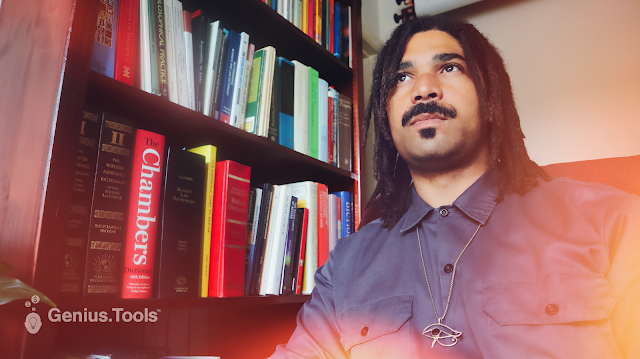
About @ibburckhardt (Issiah B. Burckhardt)
As technical philosopher, Issiah is committed to providing practical tools and wisdom to help individuals and organisations fulfil their potential. His work spans various fields, including philosophy, psychology, design, engineering, technology, and education, where he continually explores scientific enquiry to enhance self-reliance and personal development.
About Genius.Tools
Genius.Tools is a Melbourne-based start-up specialising in education innovation. By integrating the latest research and technology, Genius.Tools offers solutions tailored to the modern educational environment and organisational training. The team is driven by a shared passion for creativity and excellence, empowering learners and educators alike.
